TO BE, THERE TO BE, PRESENT CONTINUOUS
6 min de leitura · publicado em
VERB TO BE
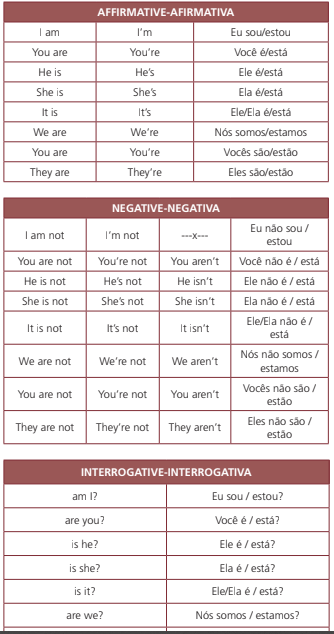
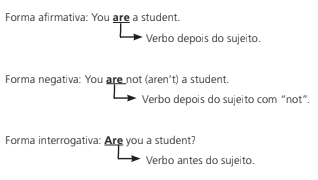
Exemplos:
I’m Brazilian.
She’s a very intelligent girl.
They are engineers at Petrobras.
You are on the 10th oor.
I’m not in São Paulo now. I’m in Rio.
He isn’t a good soccer player.
We are not doctors, we are engineers.
Are you a scientist at Instituto Vital Brasil?
Are they near the beach?
Is it a good Hospital?
VERBOS THERE IS, THERE ARE
Os verbos There is, There are estão no tempo presente e equivalem ao verbo haver no sentido de existir em português. There is é usado antes de coisas ou pessoas no singular, e there are é usado antes de coisas ou pessoas no plural.
As formas dos verbos there is e there are são:
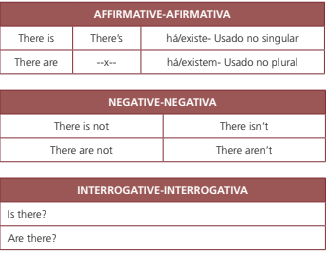
Exemplos:
There is much information on TV.
There are many students in that school.
There isn’t any car in the garage.
There aren’t many people in the stadium.
Is there much sugar in the pot?
Are there three rooms in that house?
VERBOS NO PRESENT CONTINUOUS/PROGRESSIVE
O Present Continuous ou Progressive indica uma ação que está em progresso no momento da fala. Também pode indicar ações temporárias no presente, ações futuras e acontecimentos que parecem
infindáveis no presente (hábitos irritantes).
A conjugação do “present continuous” é:
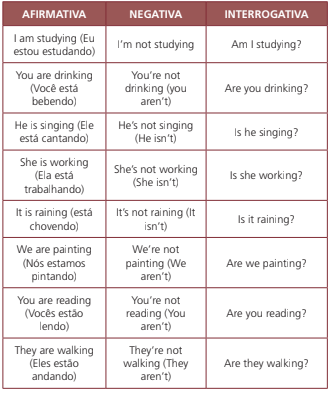
FORMAÇÃO DO PRESENT CONTINUOUS OU PROGRESSIVE
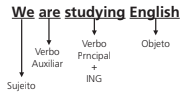
Ação ocorre no momento em que se fala.
Exemplo:
What are you doing now? I’m xing my father’s car.
Listen! Somebody is knocking at the door.
What is that music you’re playing?
Ação temporária que ocorre num período de tempo no presente, mas não necessariamente no momento em que se fala.
Exemplos:
Paul is reading a book of Jorge Amado.
The U-2 is performing at Maracanã.
People are eating less meat nowadays.
Indicar uma ação futura.
Exemplo:
Hurry up! The plane is leaving soon.
She is visiting her mother in Niterói tomorrow.
I’m on vacation at the moment, but I’m starting a new course next week.
Descreve e enfatiza uma série de acontecimentos infindáveis.
Nesse tipo de ação geralmente usamos advérbios como “always, forever or constantly” e outros advérbios de frequência.
Exemplo:
She’s always trying to show that she knows more than everyone else.
I’m constantly having to remind you to tidy up your things.
Formação do sufixo “ing” com alguns verbos:
• Verbos de uma só sílaba, terminados por consoante precedida de uma única vogal, dobram essa consoante para o acréscimo de –ing:
beg begging
hit hitting
stop stopping
• Verbos teminados em –e perdem o –e para o acréscimo de –ing:
bake baking
love loving
rise rising
• Verbos terminados em –ee conservam essa terminação para o acréscimo de –ing:
agree agreeing
flee fleeing
see seeing
• Verbos terminados em –ie perdem essa terminação e recebem –y antes da colocação de –ing:
die dying
lie lying
tie tying
• Qualquer verbo terminado em –y é simplesmente acrescido de –ing:
obey obeying
study studying
play playing
cry crying
• Verbos terminados em –l precedido de uma única vogal dobram essa consoante para o acréscimo de –ing (regra válida para o inglês britânico); quando o –l for precedido de duas vogais, a duplicação não é efetuada:
label labelling
steal stealing
feel feeling
• Verbos com mais de uma sílaba, terminados por consoante precedida de apenas uma vogal, dobram essa consoante, se o acento tônico recair na segunda sílaba; se não, apenas recebem –ing:
begin beginning
permit permitting
master mastering
open opening
TEXT COMPREHENSION
TEXT 1
By the end of the first quarter of the nineteenth century a number of our Eastern institution – Harvard, Yale, Columbia, and Pennsylvania had some of the necessary ingredients of a university, but hardly yet the point of view. They were little clusters of schools and institutes. Indeed, just after the Revolution, the schools of Pennsylvania and Harvard had assumed the somewhat pretentious title of university, and, shortly after, the University of Virginia was founded under the guidance of Thomas Jefferson. In the South, Georgia and later North Carolina began to rise. The substance in all these was mainly lacking
though the title was honored. There were rather feeble law medical and divinity schools, somewhat loosely attached to these colleges. It has been commonly recognized, however, that the first decade after
the close of the Civil War, that is, from about 1866 to 1876, was the great early flowering of university idea in America.
- (IME) In the opinion of the author of this passage, in 1825
a) only Harvard, Yale, Columbia and Pennsylvania could truly be called universities.
b) all American educational institutions could justifiably claim to be universities.
c) those institutions which called themselves universities were not justified in doing so.
d) those institutions which called themselves universities were justified in doing so.
e) no American institution of higher education had any of necessary ingredients of a university. - (IME) Thomas Jefferson founded
a) the University of Pennsylvania.
b) Harvard.
c) the University of Virginia.
d) the University of Georgia.
e) the University of North Carolina. - (IME) The Civil War ended
a) about 1866.
b) about 1876.
c) about 1856.
d) during the decade from 1966 to 1876.
e) exactly in 1876. - (IME) The University idea really began to develop
- a) in the first quarter of the nineteenth century.
- b) just after the Revolution.
- c) during the last quarter of the nineteenth century.
- d) just after the Civil War.
- e) just before the Civil War
TEXT 2
“Second Wind – This is a feeling of relief that occurs after exercise has become strenuous. Whereas breathing was labored and the work felt painful before, breathing becomes easier and the work more tolerable after athletes experience a second wind. The reasons for this reduction in effort are not known. The early distress may be associated with the temporary use of anaerobic metabolism until oxygen consumption has increased and aerobic metabolism is providing a larger percentage of the energy for work. There is some support for this notion in the fact that second wind only occurs during endurance efforts. Second wind usually occurs when athletes are just beginning their training program after a long layoff. Well-trained athletes rarely experience this phenomenon, probably because their circulatory system adjust more rapidly after they become conditioned.”
(“Swimming even faster”, Ernest Maglisho)
- (AFA) According to the excerpt, second wind is _.
a) a painful exercise
b) a good sensation
c) an exercise training
d) the aerobic metabolism - (AFA) When does second wind happen?
a) During endurance efforts
b) In the beginning of a layoff
c) When athletes reduce efforts
d) When doing anaerobic exercises - (AFA) __ do not feel second wind often.
a) Athletes who have a good preparation
b) Athletes who have strenuous breathing
c) Athletes who have increased the use of anaerobic consumption
d) Athletes who have a good experience with this kind of phenomenom
Conteúdo publicado originalmente no ProMilitares, que agora faz parte do Eu Militar.
Inglês para as Forças Armadas
Estamos montando o curso de Inglês pensado só para as provas militares, direto no que cai, com as questões das bancas. Entre na lista de espera e seja avisado primeiro quando as matrículas abrirem.
- Interpretação de texto e gramática das provas
- Questões resolvidas da EEAR, ESA e EsPCEx
- Foco nos assuntos que mais caem